Foot-and-mouth disease (FMD) isn’t just a headline for farmers—it’s a direct hit to the South African soul. When movement bans kick in and export markets slam shut, the ripples travel from the commercial feedlots of the Free State to your Friday night braai.
As of February 2026, the situation has escalated, with new cases in the Western Cape triggering rapid vaccination drives and tighter controls. Here’s a look at why this keeps happening, what it’s costing us, and how we can actually fix it.
1. Why is this happening (again)?
There is no “Patient Zero” here; it’s a perfect storm of biology, geography, and logistics.
The Wildlife Factor: African buffalo are natural reservoirs for FMD. In areas like the Kruger ecosystem, the “wildlife-livestock interface” is a permanent risk zone.
Porous Borders: Livestock don’t carry passports. With outbreaks reported in Mozambique and Zimbabwe, the virus moves across regional lines regardless of domestic efforts.
The “Traceability Gap”: If you can’t track where a cow came from, who owned it, or where it’s been, you can’t stop a virus. Currently, our documentation is uneven, making quarantine a game of guesswork.
Festive Season Pressure: December and January see a massive surge in cross-border movement. While humans don’t “catch” FMD, the sheer volume of unregulated movement of animal products and people during the holidays acts as a viral superhighway.
2. Impact: More Than Just a Farm Problem
In South Africa, beef is culture. Whether it’s biltong, boerewors, or a Sunday potjie, we are a nation of meat lovers.
Economic & Social Consequences
Impact Area
What’s Actually Happening
Household Costs
Supply disruptions and quarantine costs push retail prices up. Your steak is getting more expensive.
Trade Bans
Major markets like China and Namibia have historically hit the “pause” button on SA beef, costing the economy billions.
Productivity
Infected animals lose weight and produce less milk, hurting both the beef and dairy sectors.
Rural Jobs
Smaller communal farmers often suffer the most, as they lack the “biosecurity” infrastructure to weather long bans.
The Inflation Angle: By late 2025, Statistics SA already flagged high annual increases for red meat. FMD acts as a “cost-push” factor—vaccines, logistics, and compliance aren’t free, and those costs eventually land on the consumer’s plate.
3. How This Compare to 2019?
We’ve been here before. The 2019 outbreak was a massive wake-up call that stripped South Africa of its “FMD-free” status.
What’s different in 2026? The anxiety is wider. We aren’t just looking at isolated clusters; we’re seeing “geographic anxiety” as cases pop up in previously unaffected districts. However, the response is also faster—budgets are being allocated more aggressively, and the push for local vaccine production is stronger than ever.
4. The Path Forward: Short-Term vs. Long-Term
A) The “Emergency” Toolkit (Right Now)
Movement Controls: Roadblocks and permit checks.
Pro: Breaks the transmission chain fast.
Con: Massive economic pain for transporters and farmers.
Ring Vaccination: Vaccinating everything in a circle around an outbreak.
Pro: Scalable and practical.
Con: Depends on cold-chain logistics and vaccine supply.
B) The “Structural” Toolkit (The Future)
Digital “Animal Passports”: A national livestock identification system.
Pro: Enables “biosecurity by design” and makes us credible to global trade partners.
Zoning Strategy: Creating “FMD-free zones” that are strictly fenced and monitored.
Pro: Protects export corridors even if there’s an outbreak elsewhere.
Regional SADC Coordination: We can’t fix this alone. We need synchronized surveillance with our neighbors.
5. Calling All Techies: 10 AI Project Ideas for SA Students
The FMD crisis is a data problem waiting for a solution. Here are 10 ideas for South African students looking to build something impactful:
Cattle Facial Recognition: Use computer vision to identify individual cows without expensive physical tags.
Movement Prediction Models: Use historical data to predict which auction routes are highest risk for virus spread.
NLP for Early Warning: A tool that “listens” to informal farmer WhatsApp groups or radio to flag early signs of illness.
Satellite Fence Monitoring: Use AI to detect breaks in veterinary fences around national parks.
Blockchain Traceability: A “farm-to-fork” ledger that proves an animal has never left a disease-free zone.
Symptom-Check Chatbot: A lightweight WhatsApp bot for communal farmers to upload photos/videos of sick animals for instant triage.
Smart Cold-Chain Sensors: IoT devices that use AI to predict when a vaccine fridge is about to fail.
Cross-Border Heatmaps: Integrating border traffic data with regional outbreak alerts to visualize “risk surges.”
Meat Price Predictor: A model for consumers and retailers to forecast beef price hikes based on movement ban data.
Drone Surveillance: AI-powered drones to monitor illegal livestock crossings in remote border areas.
The Bottom Line: We can’t just “wait out” FMD. It requires a mix of old-school boots on the ground (vets and fences) and new-school tech (traceability and data). Without it, our braai culture—and our economy—will keep feeling the heat.
We are currently standing in the long shadow of history. As we move through 2026, we find ourselves just a few years away from the 100th anniversary of the Great Depression (1929–2029). It’s a sobering milestone that forces us to look at the cracks in our current global foundation and ask: Are we about to repeat the same mistakes, or are we capable of a radical redesign?
The phrase “breaking all bonds of fellowship” sounds like the prologue to a dark ages revival. But in a world where old alliances are fraying, it might be time to stop mourning the “old way” of doing things and start building something that actually fits the 21st century.
The Transatlantic Wobble: US-EU Relations on the Brink
For decades, the US-EU alliance was the bedrock of global stability. Today, that bedrock is looking more like shifting sand. Relations are currently under exceptional strain, with many analysts suggesting the partnership is on the brink of collapse.
Between transactional bargaining, tariff threats, and a growing European desire for “strategic autonomy,” the “special relationship” is in marriage counseling, and the sessions aren’t going well. Europe is realizing it can no longer outsource its security and economic certainty to a partner whose domestic politics are increasingly unpredictable.
The Ghost of Isolationism
This isn’t the first time the United States has flirted with pulling back the curtains and locking the front door. The U.S. tried the isolationist policy before, most notably during the interwar period.
The Smoot-Hawley Tariff Act of 1930 serves as a grim reminder of what happens when major powers treat global interdependence as a nuisance. It didn’t protect the American economy; it deepened the global agony. However, we have to acknowledge a hard truth: it is a different world from 100 years ago. A century ago, “going it alone” was a choice; today, with our hyper-integrated supply chains, cyber-dependencies, and shared climate risks, “isolationism” is less of a policy and more of a slow-motion economic suicide pact.
Alliances Still Matter—But They Need to Shift Shape
If the old bonds are breaking, we shouldn’t try to scotch-tape them back together. We need to reshape them. The alliances of the future shouldn’t be based on “big brother” dynamics or cold-war relics. They need to be:
Reciprocal: No more one-way dependencies.
Resilient: Built to survive political mood swings in any one capital.
Localized: Focused on regional strengths and mutual growth.
“If ‘fellowship’ means blind loyalty and one-sided expectations, then yes, it deserves to be broken. But if it means shared problem-solving, then we don’t need fewer allies—we need better-structured ones.”
The Europe-Africa Pivot: From Empire to Equal Partnership
Perhaps the most significant “shift” available is the relationship between Europe and Africa.
A hundred years ago, there was a “fellowship” of sorts between these two continents, but let’s be honest: it was built on empirist principles, extraction, and colonial hierarchy. It wasn’t an alliance; it was an occupation.
Today, the opportunity is entirely different. As the transatlantic link wobbles, the bridge between Europe and Africa must be strengthened—but this time, on equal, mutually beneficial terms.
Beyond Slogans: Real Trade and Skills Exchange
A modern Europe-Africa alliance isn’t about “aid”; it’s about rational statecraft.
Trade: Europe needs diversified supply chains; Africa needs industrial capacity and infrastructure investment that respects sovereignty.
Skills Exchange: Europe faces demographic aging, while Africa possesses a massive, talented youth population. If managed through safe, legal, and reciprocal pathways, this is a win-win for global innovation.
The Cultural Bridge: Speaking the Same Language
For too long, the cultural exchange has been a one-way street. Africans already share many European cultures and languages through history and education. To reach true “equal terms,” Europe must be prepared to meet Africa halfway.
It is time for European diplomatic and commercial institutions to treat major African languages like Zulu, Swahili, and Hausa with the same strategic importance as Mandarin or Spanish. Learning these languages isn’t just a polite gesture; it’s a serious investment in building trust and accessing some of the world’s fastest-growing markets.
The Verdict
We don’t need to break all bonds of fellowship. We just need to break the ones that no longer serve the reality of 2026. By moving away from the “paternalistic” models of the past and toward a multilateral, reciprocal partnership between Europe and Africa, we might just find the stability that the old world is currently losing.
The next decade will reward those who can redesign their alliances before the old ones finish collapsing. The next decade will reward blocs and regions that can:
reduce single-point dependencies,
build credible regional capacity,
treat partnerships as two-way value creation,
keep channels open even when politics gets loud.
In that world, a strengthened Europe–Africa alliance—built deliberately on mutual benefit rather than imperial memory, may be one of the most strategically sensible “new shapes” of fellowship available.
1. Summary: The General Assembly at 80 – A Global Convener in a Multipolar Era
As the United Nations General Assembly (GA) marks its 80th anniversary, its role as the world’s premier forum for multilateral negotiation and deliberation has proven both enduring and paradoxically challenged. Founded in 1945 as the chief deliberative and representative body of a mere 51 nations, it has grown to encompass 193 Member States, reflecting a global community that is larger, more complex, and more deeply interconnected than its founders could have imagined.
This report examines the GA’s achievements, limitations, and future trajectory, with a particular emphasis on its profound impact on the African continent. The analysis reveals a body of immense moral and political authority that, despite its lack of binding enforcement power, has been instrumental in shaping the post-war international order. The GA’s defining achievements include its central role in the decolonization of Africa and Asia, its ability to adapt to the geopolitical paralysis of the Cold War, and its function as the principal architect of global development and climate agendas. Its non-binding resolutions have consistently served as a powerful instrument of moral suasion, catalyzing change by providing a unified political and legal foundation for collective action.
The report highlights the GA’s pivotal role in fostering self-determination and dismantling apartheid in South Africa. It traces the body’s evolution from a Cold War battleground to a forum for a new multipolar reality, underscored by the rise of new global powers like China and India. The analysis of its economic and climate-related work demonstrates a shift from broad, aspirational goals to pragmatic, time-bound targets, such as the Sustainable Development Goals (SDGs), while also revealing significant implementation gaps.
Ultimately, the report concludes that the GA’s future relevance depends on its ability to bridge the persistent gap between its universal representation and its limited enforcement authority. The ongoing debates over Security Council reform and the revitalization of the General Assembly itself are not merely procedural; they represent a fundamental struggle over the future distribution of global power and the legitimacy of the international order. The GA is not simply a physical space in New York but a dynamic process, a living reflection of the world’s most pressing challenges and its collective aspirations.
2. Introduction: The UN General Assembly as a Global Nexus
The United Nations General Assembly, established under the Charter of the United Nations in 1945, holds a central position as the chief deliberative, policymaking, and representative organ of the global institution. Comprised of all 193 Member States, the GA provides a unique forum for multilateral discussion on the full spectrum of international issues covered by the Charter, from political and economic matters to humanitarian and legal questions. Its mandate extends to standard-setting, the codification of international law, and making recommendations to States on a wide range of issues within its competence.
A fundamental aspect of understanding the GA’s function is distinguishing it from the Security Council (SC). While the Security Council bears the “primary responsibility for the maintenance of international peace and security” and its resolutions can be legally binding, the General Assembly operates through recommendations. The SC has 15 members, with five permanent members holding veto power, a feature that has historically led to political gridlock. In contrast, the GA is a universal body where each member state has one vote, fostering a more equitable and representative decision-making process. This distinction, the GA’s power of persuasion versus the SC’s power of enforcement, is a recurring theme that defines the Assembly’s achievements and limitations throughout its history.
This report will explore the evolution of the General Assembly over eight decades, analyzing its key achievements and the enduring challenges it faces. The narrative is structured thematically, beginning with the transformative impact of decolonization on the Assembly’s identity and proceeding to its engagement in peace and security, economic development, and climate action. The analysis will consistently focus on the African experience as a central case study, demonstrating how the continent’s history and advocacy have profoundly shaped the GA’s agenda and priorities.
3. The Decolonization Imperative: The GA’s Defining Achievement in Africa
The mid-20th century witnessed a fundamental transformation of the General Assembly, driven by the emergence of newly independent nations in Africa and Asia. This influx of new members, often referred to as the “Third World Majority,” fundamentally altered the GA’s composition and agenda, shifting it from a body dominated by Western powers to a platform for anti-colonial politics. This demographic and political shift culminated in what many consider the GA’s most significant achievement: its role in accelerating the end of imperialism.
The Birth of a New World Order
A pivotal moment came with the adoption of UN General Assembly Resolution 1514, the “Declaration on the Granting of Independence to Colonial Countries and Peoples,” on December 14, 1960. This landmark resolution was a watershed event, providing a powerful legal and moral framework for independence movements across the globe. It affirmed that the subjection of peoples to foreign subjugation was a denial of fundamental human rights and a threat to world peace. More importantly, it declared the inalienable right of all peoples to self-determination, emphasizing that “inadequacy of political, economic, social or educational preparedness should never serve as a pretext for delaying independence”.
This declaration, which was adopted by a vote of 89 to none with nine abstentions, was a powerful show of force that resonated with independence movements everywhere. The GA’s subsequent creation of a special committee to monitor the resolution’s implementation ensured that its principles were not merely symbolic but translated into concrete action. The UN Trusteeship System, a precursor to Resolution 1514, had already begun overseeing the transition of former League of Nations mandates toward self-government or independence, with all 11 of these territories having achieved self-governance by 1994. The GA’s role as a catalyst for change was evident in how Resolution 1514 inspired and empowered nations across Africa and Asia to seek, and often rapidly achieve, independence.
Case Study: The Anti-Apartheid Movement
The GA’s enduring power of moral suasion is most powerfully demonstrated in its sustained campaign against apartheid in South Africa. Beginning in 1962, the Assembly passed Resolution 1761, a non-binding resolution that condemned the regime and called for a voluntary economic boycott and arms embargo. More significantly, it established the UN Special Committee Against Apartheid to monitor and publicize the regime’s policies.
The General Assembly’s non-binding resolutions on apartheid were not merely symbolic gestures. They provided a unified moral and political foundation that made the regime an international pariah. This unified front enabled and encouraged individual member states to take independent action, such as breaking off diplomatic relations or imposing their own sanctions. The GA’s suspension of South Africa from participating in its work in 1974 further isolated the regime. The cumulative effect of this global pressure, amplified by the GA, ultimately made the apartheid system economically and politically unsustainable, leading to the release of Nelson Mandela and the country’s first democratic elections in 1994. This example illustrates a fundamental aspect of the GA’s power: even without the ability to enforce its decisions, its collective political and moral authority can be a potent force for global change.
The following table summarizes the key milestones in this transformative period:
Resolution
Date
Purpose
Impact on Africa
1514 (XV)
December 14, 1960
Declaration on the Granting of Independence to Colonial Countries and Peoples.
Provided a legal and moral framework for independence, accelerating the decolonization of African and Asian nations.
1761 (XVII)
November 6, 1962
Condemnation of apartheid in South Africa; called for voluntary sanctions and established the UN Special Committee Against Apartheid.
Catalyzed a global anti-apartheid movement, isolating the South African regime politically and economically.
Suspension of South Africa
November 12, 1974
Suspended South Africa from the work of the GA due to its apartheid policies.
Signified a high point of international opposition, further isolating the regime and bolstering the anti-apartheid cause.
International Decade for the Eradication of Colonialism
1990–2000 and 2001–2010
Declared two decades to focus on eliminating all remaining manifestations of colonialism.
Reaffirmed the UN’s commitment to self-determination and addressed remaining territories, including small island states.
Export to Sheets
4. Peace and Security: The GA in a World of Conflict
The United Nations was founded with the central mission of maintaining international peace and security, a role primarily assigned to the Security Council. However, the Security Council’s effectiveness has often been hamstrung by the veto power of its five permanent members (P5), leading to paralysis during key moments of geopolitical tension, particularly throughout the Cold War.
The Cold War Dilemma and “Uniting for Peace”
In response to the Security Council’s inaction during the Korean War, the General Assembly adopted the “Uniting for Peace” resolution (377 (V)) in 1950. This resolution empowers the GA to convene an Emergency Special Session to consider a matter of international peace and security and make recommendations for collective measures, including the use of armed force, when the Security Council fails to act due to a permanent member’s negative vote. This procedural innovation provided the UN with an alternative avenue for action, effectively circumventing the P5 veto. The resolution was a critical tool during the Cold War, invoked on 13 occasions between 1951 and 2022 to address crises such as the Suez Crisis, the Hungarian Revolution, and the Soviet invasion of Afghanistan. The 2022 invocation regarding the Russian invasion of Ukraine demonstrates its continued relevance in the face of contemporary geopolitical divisions.
Conflict Trends Since 1945
While the UN was founded to prevent another global conflict of the scale of World War II, a review of conflict trends reveals a more complex reality. The post-1945 era has seen a significant decline in large-scale interstate wars, a trend that can be attributed, in part, to the diplomatic and deterrent effects of international institutions. However, the nature of global violence has evolved. The period has been marked by a proliferation of intrastate conflicts, civil wars, and violence targeting civilians, with a significant number of these conflicts concentrated in Africa and the Middle East.
The shift from interstate to intrastate conflicts reveals a fundamental change in the nature of global violence that the UN, in its original design, was ill-equipped to handle. The GA’s role has had to adapt from deterring state-on-state aggression to addressing internal civil strife and humanitarian crises. The organization’s inability to prevent or effectively de-escalate major humanitarian tragedies, such as the Rwandan genocide, the Srebrenica massacre, and the ongoing conflict in Darfur, has been a consistent point of criticism and a source of profound institutional challenge. The UN’s response in these instances was often viewed as ineffective or late, with critics noting the lack of consequences for states that violate Security Council resolutions.
The GA’s Role in Peacekeeping
The General Assembly plays a critical, albeit indirect, role in the UN’s peacekeeping efforts. While the Security Council authorizes peacekeeping missions, the GA holds the power of the purse, approving the budget for all UN operations. This financial authority gives the GA a powerful, albeit subtle, influence over the scope and duration of missions. For example, the first peacekeeping operation in Africa was deployed in the Congo in 1960, and since then, thousands of peacekeepers have been deployed to over 30 operations on the continent.
The GA’s budgetary control over peacekeeping missions has become a point of political leverage for member states, allowing them to indirectly shape the scope, duration, and even existence of a mission, despite the Security Council’s primary mandate. The debate over UN peacekeeping is ongoing, with some members advocating for missions to return to “core mandates” and others stressing the continued relevance of broader mandates that include civilian protection and human rights. This demonstrates a complex and evolving dynamic where the GA’s financial power and the SC’s primary political authority intersect to determine the nature of UN action on the ground.
5. The Shifting Global Order: A Reflection of Evolving Geopolitics
The General Assembly has historically served as a critical barometer of global power dynamics, reflecting and shaping the geopolitical realities of its time. Its evolution from a post-war forum dominated by a Western majority to a more fragmented and representative body is a testament to its adaptive capacity.
The Cold War Battleground
In its early decades, the GA became a key platform for the ideological struggle between the United States and the Soviet Union. Both superpowers utilized the GA for “propaganda” and to rally support for their respective causes. However, this bipolar dynamic was fundamentally altered by the influx of newly independent nations from Africa and Asia. By the 1970s, UN membership had more than doubled, and these new members increasingly formed a cohesive bloc, the Non-Aligned Movement (NAM).
The NAM, which sought a “middle course” between the two superpowers, wielded significant voting power in the General Assembly, often siding with the Soviet Union on anti-colonial issues and challenging Western dominance. This shift in voting dynamics was most dramatically illustrated in 1971, when, despite U.S. efforts, the GA voted to replace Taiwan with the People’s Republic of China in both the General Assembly and the Security Council. This landmark resolution not only legitimized the PRC’s government but also granted it a permanent seat and veto power in the Security Council, a significant reshaping of the global power structure.
The Fall of the Soviet Union and the Rise of New Powers
The dissolution of the Soviet Union in 1991 marked a profound turning point. The Russian Federation assumed the USSR’s seat, rights, and obligations under the UN Charter. The end of the Cold War created a “unipolar moment” in which the Security Council, no longer paralyzed by the US-Soviet rivalry, became more decisive and effective, as demonstrated by its swift action against Iraq’s invasion of Kuwait in 1990.
The contemporary geopolitical landscape is defined by the continued rise of new global powers, most notably China and India. India, as a member of the G4 (a group also comprising Brazil, Germany, and Japan), is now a leading voice in the push for Security Council reform. This group is advocating for permanent seats on the Security Council to reflect the “power realities” of the 21st century. The fact that these nations are lobbying for reform in the General Assembly underscores the GA’s enduring role as the primary forum for legitimizing and negotiating a new, more equitable world order. This ongoing debate reveals that the push for UN reform, while focused on institutional structures, is fundamentally a struggle over the future distribution of global power.
6. Economic and Social Development: From Theory to Practice in Africa
From its inception, the UN Charter has emphasized the promotion of international cooperation in economic, social, and developmental fields. The General Assembly has been the driving force behind the UN’s development agenda, particularly in Africa.
The Role of UNECA and the Evolution of a Global Agenda
The GA’s commitment to development was formalized in the 1960s with the declaration of the “United Nations Development Decade”. This initiative encouraged member states to create opportunities for developing countries in the global market and promote self-sustaining economic growth through industrialization and diversification. A key outcome of this era was the establishment of the UN Economic Commission for Africa (UNECA) in 1958. UNECA’s mandate is to promote economic and social development, foster intra-regional integration, and provide advisory services and policy research to its 54 member states. UNECA has been instrumental in supporting initiatives like the African Continental Free Trade Area (AfCFTA), recognizing that intra-African trade would be significantly higher with its full implementation.
The Sustainable Development Goals (SDGs)
The General Assembly’s most ambitious and comprehensive development agenda to date is the 2030 Agenda for Sustainable Development, adopted in 2015. This agenda is a “roadmap” for all countries, rich, poor, and middle-income, to “promote prosperity while protecting the planet”. It consists of 17 Sustainable Development Goals (SDGs), a set of specific, time-bound targets designed to end poverty, protect the planet, and tackle inequality.
The SDGs represent a maturation of the UN’s development work, shifting from broad, aspirational goals to pragmatic and measurable targets. This evolution reflects an understanding that turning recommendations into tangible progress requires a clear, actionable blueprint. While progress has been made, for instance, the number of people without access to electricity was halved between 2010 and 2021, and the gender gap in education continues to shrink, the GA recognizes that a significant implementation gap persists. A 2023 analysis found that only 35% of SDG targets were on track, with nearly half progressing too slowly and 18% actually regressing. In response, the GA adopted the “Pact for the Future” in 2024 to “turbocharge” progress on the SDGs and accelerate their implementation.
The following table summarizes key SDGs and provides an overview of their progress and relevance to Africa:
SDG Number & Goal
Description & Relevance to Africa
Progress & Challenges
SDG 1: End Poverty
A call to eradicate poverty in all its forms. Highly relevant to Africa, where over 800 million people still live in extreme poverty and hunger.
Status: Progress is too slow; over 800 million people still live in extreme poverty and hunger.
Challenges: The ongoing impact of global crises, including economic downturns and conflicts, exacerbates poverty.
SDG 2: Zero Hunger
Aims to end hunger, achieve food security, and improve nutrition. Directly addresses systemic food insecurity affecting 2.4 billion people globally.
Status: One in 11 people still face hunger.
Challenges: Food gaps negatively impact economic development. The UN Food and Agriculture Organization (FAO) and the World Food Programme (WFP) are central to this effort.
SDG 5: Gender Equality
Aims to achieve gender equality and empower women and girls.
Status: Strides have been made in enacting legal reforms to promote gender equality and increase access to education for girls. Rwanda has the highest proportion of women in parliament globally.
Challenges: Women still shoulder 2.5 times more unpaid care work than men, and discrimination in the workplace persists.
SDG 7: Clean Energy
Aims to ensure access to affordable, reliable, sustainable, and modern energy for all. Essential for economic growth and sustainable development in developing countries.
Status: The number of people without access to electricity was cut in half between 2010 and 2021.
Challenges: Funding for clean energy in developing countries is in decline, and just 19 countries received 80% of committed financial flows in 2021.
7. Climate Action and Global Warming: A New Frontier for the GA
Climate change represents a defining challenge of the 21st century, and the General Assembly has emerged as a crucial forum for building political will and shaping international norms on the issue.
Africa’s Vulnerability and Advocacy
The African continent is disproportionately affected by the impacts of climate change, from droughts and desertification to rising sea levels, despite contributing minimally to global greenhouse gas emissions. In response, African nations have been instrumental in shaping international climate law and advocating for a more equitable global response. They have long championed the principle of “common but differentiated responsibilities,” which holds developed nations, responsible for the vast majority of historical emissions, to a greater obligation to lead in cutting emissions and providing financial and technological support to vulnerable nations.
The GA as a Moral and Political Impetus
While the United Nations Framework Convention on Climate Change (UNFCCC) and its annual Conference of Parties (COPs) are the primary venues for climate negotiations and agreements, the General Assembly plays a critical complementary role. Through its resolutions, the GA can provide political impetus to specific issues and serve as a powerful forum for states to voice their concerns.
A series of landmark resolutions demonstrates the GA’s growing authority in this domain. In 2022, a Costa Rican-led effort resulted in a resolution recognizing the right to a clean, healthy, and sustainable environment, which passed with 161 votes. A 2023 resolution from Vanuatu requested an advisory opinion from the International Court of Justice (ICJ) on the obligations of states regarding climate change, with over 130 countries co-sponsoring the resolution. These resolutions, while not legally binding, are powerful examples of “soft law” in action. By bringing a large coalition of nations together to vote for a particular principle, the GA creates a global consensus that exerts moral and political pressure on states to act, even outside of formal treaty obligations. This is a critical function for a body with limited enforcement power, as it helps to legitimize new international norms and galvanize action. The GA’s high-level gatherings, such as the 2023 Climate Ambition Summit, have also provided crucial momentum for key agreements, including the landmark COP28 agreement’s text on transitioning away from fossil fuels.
8. Enduring Challenges and the Future of Multilateralism
Despite its many achievements, the General Assembly and the broader UN system face significant criticisms and enduring challenges in a rapidly changing world. The GA is often criticized for a perceived lack of efficacy in preventing or de-escalating major conflicts, such as the wars in Ukraine and Gaza, where the Security Council remains hamstrung by deep-seated P5 divisions. The non-binding nature of GA resolutions is a consistent point of contention, with critics arguing that they often represent the “lowest common denominator” of opinion and lack real-world impact. The UN system also faces severe financial strain due to a shortfall in member state contributions, a problem exacerbated by geopolitical tensions and a waning interest in multilateralism among some key donors.
Reform Proposals and a Struggle for Relevance
The core of the malaise facing the UN lies in the “frozen debate” over reform. The debate is not merely about institutional structures but reflects a fundamental struggle over the future distribution of global power. The G4 nations like Brazil, Germany, India, and Japan are advocating for permanent Security Council seats to better reflect the geopolitical realities of today. This call is opposed by the Uniting for Consensus group, which favors expanding only the non-permanent seats, while the L.69 Coalition of developing countries insists on expansion in both categories to ensure greater equity.
Simultaneously, there is an ongoing and decades-long discussion on revitalizing the General Assembly itself. Proposals include strengthening the GA’s authority in peace and security, improving coordination between the GA and the Security Council, and enhancing the transparency and inclusivity of the Secretary-General selection process. These efforts reflect a pragmatic acknowledgment that the institution must either modernize to mirror the “shifting realities of the contemporary global order” or risk becoming irrelevant.
New Horizons for a Multipolar World
In response to global fragmentation and mistrust, UN Secretary-General António Guterres launched a series of initiatives under the “Our Common Agenda” banner, culminating in the “Summit of the Future” in 2024. The summit’s outcome, the “Pact for the Future,” is a direct attempt to “reimagine and revitalize” multilateral systems to address 21st-century challenges. The Pact focuses on a wide range of issues, from AI governance and digital connectivity to a new agenda for peace that seeks to mitigate great power rivalries. This push for institutional and programmatic reform is an acknowledgment that the world order is shifting and that a new form of “networked and inclusive multilateralism” is required to address global threats that have locked states into interdependence.
9. Conclusion: The General Assembly at 80
The General Assembly, at 80 years old, remains an indispensable pillar of the international system. While it has not succeeded in its founding mission to “save succeeding generations from the scourge of war” in every instance, its role as a global convener and a platform for moral suasion and consensus-building has been essential. The GA’s greatest achievements, the acceleration of decolonization and the establishment of global development and climate agendas, were not a function of military or economic might but a result of the collective will of its members, particularly the African and Asian blocs, which harnessed the power of the forum to shift international norms.
The Assembly’s future relevance is inextricably linked to its ability to adapt to a multipolar and fragmented world. The ongoing debates over Security Council reform and the revitalization of the GA itself are critical, as they represent the central struggle for a more equitable and representative global order. The UN, as an institution, is a reflection of its members. The challenges it faces, from financial strain to geopolitical divisions, are a direct result of member states’ unwillingness to compromise and fully commit to the ideals that brought them together.
Ultimately, the General Assembly is more than a building in New York. It is a dynamic process, a living, breathing reflection of the world’s most pressing issues and its collective, albeit imperfect, ambition to forge a path toward a more peaceful, just, and sustainable future.
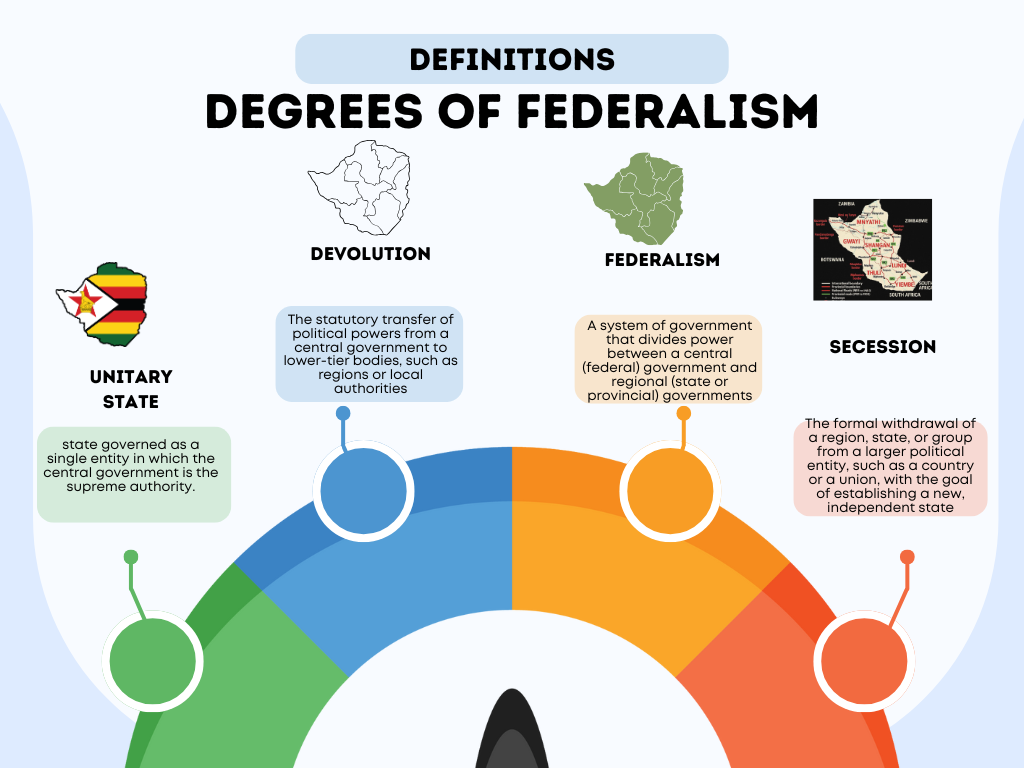
Federalism is a system of government in which power is constitutionally divided between a central (national) government and regional (state, provincial, or territorial) governments. Both levels of government have sovereignty in certain areas.
Examples:
United States: States have powers over education, policing, taxation, etc.
Nigeria, South Africa, Germany, India: Federal structures where provinces/states have their own legislatures and constitutions to varying degrees.
Key feature: The division of powers is constitutional and cannot be easily taken away by the central government without a constitutional amendment.
2. How does Federalism differ from Devolution?
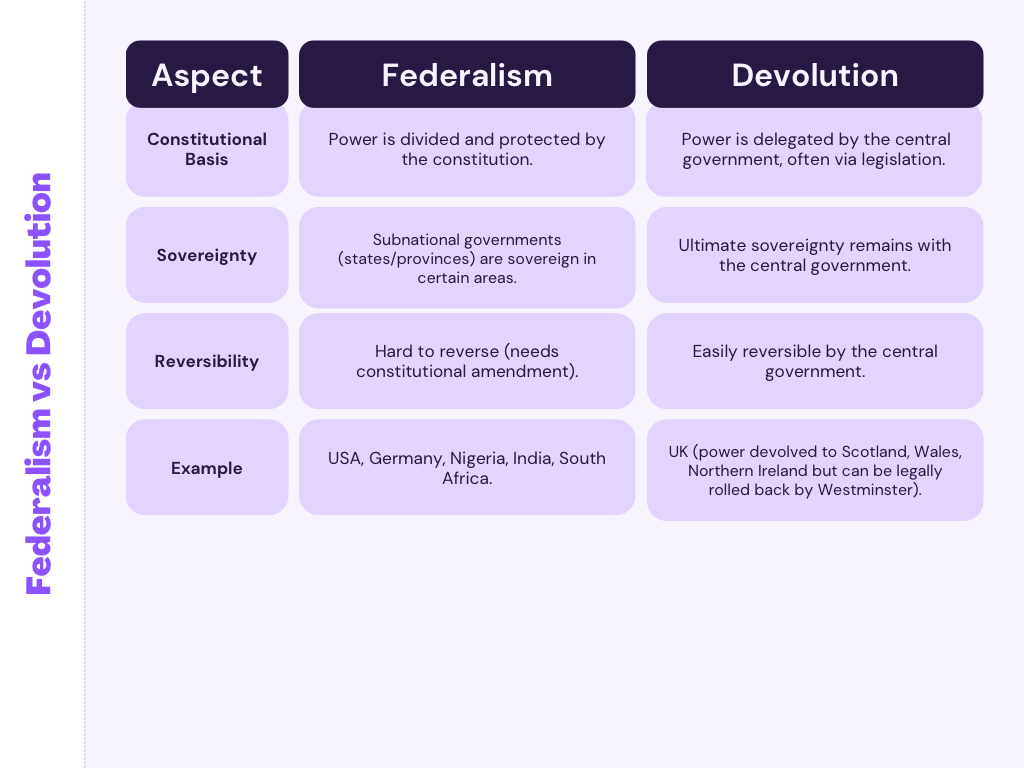
So: Federalism = shared sovereignty. Devolution = delegated authority.
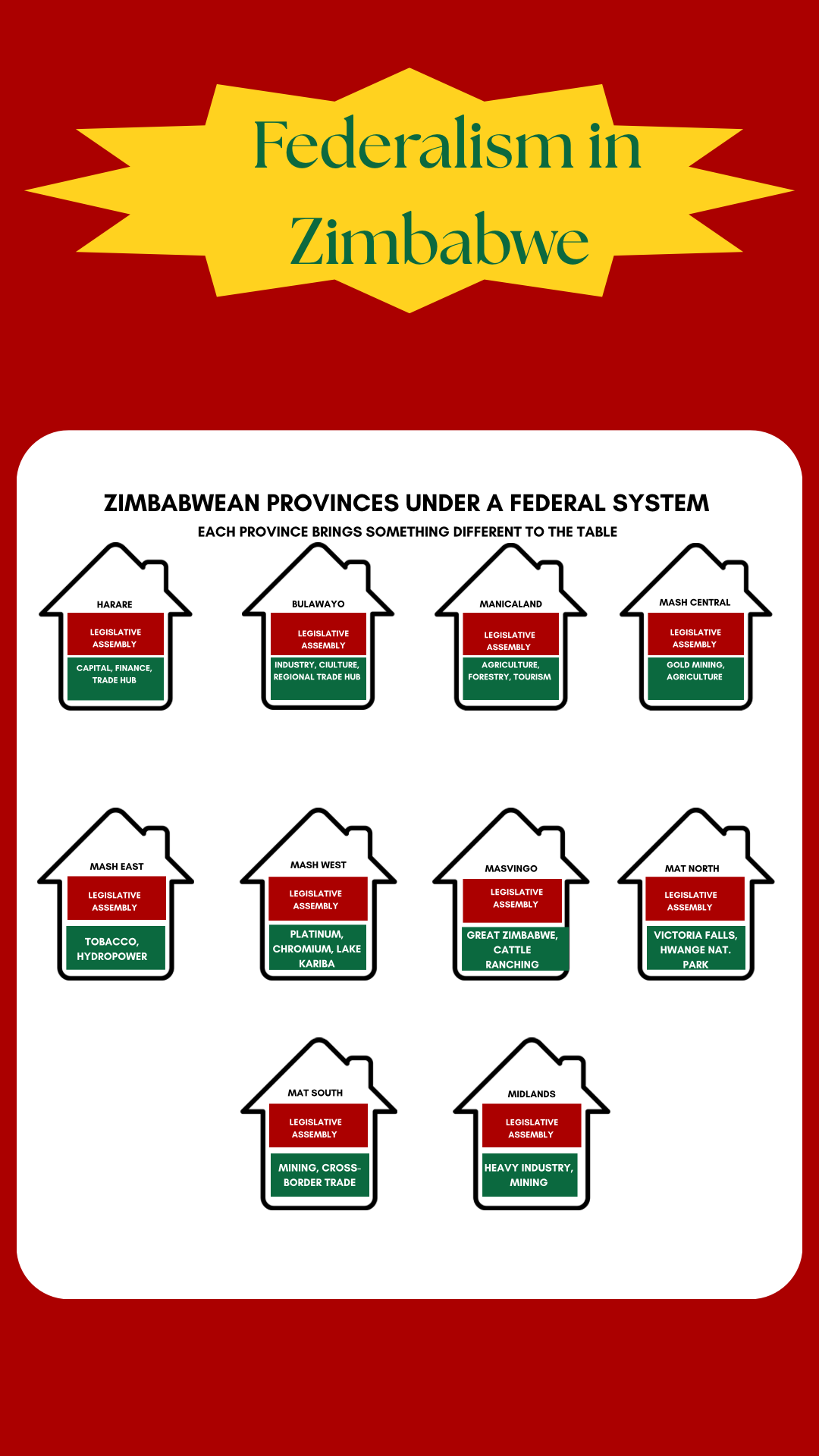
3. Can Federalism work in Zimbabwe?
Zimbabwe is currently a unitary state. The 2013 Constitution allows for “devolution” (Chapter 14) but in practice, the central government retains tight control. Provinces have Provincial Councils but very little fiscal or legislative autonomy.
For federalism to work:
The constitution would need restructuring to guarantee provinces/regions legal autonomy.
Provinces like Matabeleland, Masvingo, Manicaland, Midlands would get more power over their own resources, budgets, and policies.
National government would focus on “federal matters” like foreign policy, defense, currency, and national infrastructure.
Challenges:
Political will: Current ruling elites benefit from centralization.
Resource sharing: How to distribute wealth from resources (e.g., platinum in Mashonaland, gold in Midlands, agriculture in Manicaland, tourism in Matabeleland).
Fear of secession: Federalism could be seen as a step towards breakaway states (e.g., Matabeleland grievances).
4. Will it improve the standard of living for the marginalised?
Potentially, yes – if properly implemented:
Local accountability: Provincial governments closer to the people may respond better to needs (water, schools, roads).
Resource control: Regions could manage and benefit from their own resources instead of relying on Harare.
Reduced marginalisation: Provinces like Matabeleland, often neglected, could design policies to directly address local challenges.
Economic innovation: Regions could try different development strategies instead of a one-size-fits-all policy from the capital.
But risks remain:
Corruption: Federalism doesn’t automatically eliminate corruption—local elites could still capture resources.
Capacity gaps: Some provinces might lack the skilled administrators to govern effectively at first.
Unequal development: Wealthier provinces (e.g., with mineral wealth) may advance faster than poorer ones. A strong revenue-sharing formula would be essential.
✅ Bottom line:
Federalism offers more permanent, constitutional power-sharing than devolution.
In Zimbabwe, it could empower regions, address historical marginalisation, and improve standards of living if linked with transparency, strong institutions, and fair revenue distribution.
But without political reform and safeguards against corruption, federalism alone won’t be a silver bullet.
When I first came to South Africa in 2006 I was on leave. The main purpose of my visit was to study the job market here and then go back and come back later to look for employment. I was met at Park Station by my nephew who had lived here for some time and his first words were (in Shona) “Mazouyawo sekuru? Chero mabofu aona kuti hakuchagariki kwenyu uko” [You have finally decided to come, uncle. Even the blind can see that your country is no longer inhabitable). Today Zimbabwean beggars are found in almost all taxi terminuses and other busy intersections in affluent suburbs of Johannesburg.
The country that used to be the bread basket of Southern Africa is now contemplating importing maize even from Malawi (BlackSeaGrain -22/4/2011). Since when did Malawi, a mountainous country, which is almost one huge lake, gain a reputation as a maize producer. Surprisingly, most Zimbabweans have recently been declared Malawians. I have a friend who was born in Zimbabwe, by a Zimbabwean mother (who is now late), educated and trained as a teacher in Zimbabwe, taught in Zimbabwe for five years before deciding to come to South Africa in 2007 using her Zimbabwean passport. Her passport expired in 2008. When she tried to apply for a new one in 2010 she was told that she is a foreigner and has to go to Malawi first and denounce her citizenship because her father (whom she never knew) was from Malawi. She knows no-one in Malawi.
What kind of a country wastes state resources educating people and then declare them foreigners?
If I am not mistaken, in terms of good arable land, we are second only to Zambia in the SADC region. It’s time for the region to act. You cannot get rid of cockroaches in your own house if the neighbour’s house is dirty. Make sure the whole neighbourhood is clean.
The responsibility of Zimbabwe is food security. How can then the region be secure if Zimbabwe cannot feed its citizens?
The opposition parties have failed to deliver. Their policies and principles offer no change or solutions to the problems currently facing Zimbabwe. Their leaders have also declared themselves Life Presidents. What is needed in Zimbabwe is separation of State business from Party business, proportional representation in government and devolution of power. Of all the Political Parties currently flooding the political landscape in Zimbabwe, only ZAPU seems to be fighting for the people and not for the Presidency. When will the Zimbabweans ever enjoy their political independence? When will they ever know that true democracy means that your vote is not for sell and you should never be blackmailed into voting against your conscience?
With ZAPU one day Zimbabweans will wake up to a Zimbabwe where my wife supports and votes for MDC while I vote for ZAPU and we never fight about it. According to ZAPU policies, we will one day have Zimbabwe as a nation not as separate tribes and races dominated by Shona and Ndebele speaking people.
One day, Zimbabwe will belong to everyone who lives in it, regardless of where their grandfathers came from.
In the three decades since the Lancaster House talks brought universal suffrage to Zimbabwe-Rhodesia, voter turnout in national elections has plummetted from over 95% in 1980 to just about 43% in 2008.
A mammoth drop of about 52 percentage points; 55% to be exact. Judging by the 1980 statistic, Zimbabweans are passionate about voting.
Leading to the 1980 ballot, none of the former patrotic front parties had had the opportunity to do any meaningful voter education.
In fact, even the Lancaster House talks caught them by surprise because they had purposed to take the country through the barrel of the gun.
There had been no youths or green bombers sent to terrorise the villagers forcing them to go and vote. People spent several days in the queue of their own volution.
There were no chiefs bribed with cars or partisan village headmen with registers checking who has voted.
Still, they came in their numbers to the few polling stations which were about 20km apart.
Where, then did all this enthusiasm go? While the Gukurahundi and related activities of the early to mid 1980s saw voter turnout drop 10 percentage points in 1985, it was the bombshell of the 1987 Unity Accord which was the last straw.
Only 60% of registered voters bothered to vote in the 1990 elections. Since then, only the Zimbabwe dollar fell faster than the voter turnout.
In 2008, in a country of about 14million in habitants, there were only 5.9 million registered voters and of these, only 43% cast their votes.
Of the 43% (about 2.5 million) who voted, Tswangirai got 48%.
The monarch got 43%.What does all this statistics really mean? Tswangirayi got 48% of those who voted, who were only a mere 43% of the registered voters.
So only 20% of registered voters voted for Tswangirai. Only 20%!
Who has ever ruled a country with support from only 20% of the population? Zanu got 18%, the other MDC about 4.3% of registered voters.
Well, giving a 5% allowance to ghost voters on the voters’ roll we are still left with over 50% registered voters who have not voted since the ill-fated Unity Accord.
These are the voters who are not part to the current GNU, these are the people whose interests are not represented in the current Sadc mediated talks.
These are the people ZAPU represent. The current parties to the unending talks have long lost the mandate of the majority of Zimbabweans.
Come 2012 elections, ZAPU will restore Zimbabwe to the people of Zimbabwe.
Disclaimer: The views contained in published works are their authors’ and do not necessarily represent the views of ZimEye Media or of its editors.
1. As Jesus went about His earthly ministry, people either wanted to
follow Him, or were invited by Him; yet some desired to do so on
their own terms – Lk 9:57-62
a. “Lord, let me first go and bury my father.”
b. “Lord, I will follow you, but let me first go and bid them
farewell who are at my house.”
2. This “me first” mentality was fundamentally opposed to Jesus’ concept
of following Him…
a. He demanded that one “deny himself” to follow Him – Lk 9:23
b. He required that one “hate…his own life also” – Lk 14:26
[Living in a culture that praises putting self first and then “Looking
Out For #1”, it easy for Christians to adopt this “me first” mentality.
Consider some ways we can be guilty of…]
I. THE “ME FIRST” MENTALITY
A. IN OUR ATTENDANCE…
1. The Scriptures reveal the example and value of assembling
together with other Christians – Ac 2:42; 20:7; He 10:25
2. Yet many will often put personal interests before opportunities
to attend services:
a. Recreational outings
b. Family gatherings
c. Elective work or school related activities
d. Staying home to read or watch TV
— Haphazard attendance is a sign of the “me first” mentality
B. IN OUR CONTRIBUTION…
1. Christians are instructed to give of their prosperity to meet
certain needs – 1Co 16:1-2; 2Co 9:7-9
2. Yet many will give sparingly because:
a. They want to spend as much as possible on things for
themselves
b. They have failed to properly budget their contribution to
the Lord
c. They are burdened with bills for things that are not
necessities, but actually luxuries
— Negligent giving of our prosperity is a sign of the “me first”
mentality
C. IN OUR SERVICE TO ONE ANOTHER…
1. God has blessed each of us with gifts to serve one another – Ro
12:3-8; 1Pe 4:10-11
2. Yet many make little effort to do their part in the work of the
local congregation:
a. They do not learn the names of the other members
b. They do not seek to find their “gift” or ability God has
given them
c. Men do not attend the business meetings; women do not teach
classes
d. They may attend church, but only to receive, not to give of
themselves
— Lack of involvement in the local church is a sign of the “me
first” mentality
D. IN OUR FAMILIAL RELATIONSHIPS…
1. Christians have duties to members of their physical families
– Col 3:18-21; Ep 5:22,25,33
2. Many families suffer when people seek their own interests above
another
a. When husbands and wives are selfish in their dealings with
each other
b. When parents divorce without regard to the impact on their
children
c. When children fail to honor and obey their parents
— Dysfunctional families abound where the “me first” mentality
exists
[Our service to the Lord, His church and our families is greatly
hindered by the “me first” mentality, and is detrimental to our souls
those around us. How much better, for us to learn and practice…]
II. THE “OTHERS FIRST” PRINCIPLE
A. AS EXEMPLIFIED BY CHRIST…
1. He came to this earth because He put others first – 2Co 8:9;
Mt 20:28
2. We are called upon to adorn the same mind or attitude – Php 2:
3-8
a. To do nothing through selfish ambition or conceit
b. To esteem others better than ourselves
c. To look out for the interests of others
— Jesus exemplified the principle of “others first” that He
desires in us as well
B. AS EXEMPLIFIED BY THE MACEDONIANS…
1. Note their great liberality despite their own poverty – 2Co 8:
1-4
2. Note why they were able to be so gracious in thinking of others
first – 2Co 8:5
a. They first gave of themselves to the Lord, then to others!
b. The mentality of “Lord first” instead of “me first” enabled
them to put “others first”
3. Their liberality continued in supporting Paul to preach the
gospel – cf. Php 4:10-18
4. Putting God and others first ensured that their needs would be
met – Php 4:19
— The Macedonians exemplified the true value of putting “others
first”
CONCLUSION
1. Do we have the “me first” mentality…?
a. If we do, we cannot be Jesus’ disciples
b. If we do, the church and our own spiritual lives will suffer
2. Do we want to be rid of the “me first” mentality…?
a. The “me first” mentality will be destroyed when we adopt the
“others first” principle
b. The “others first” principle will be developed as we make “the
kingdom of God first” – Mt 6:33
When we truly put the kingdom of God and others before ourselves, then
the Lord will see to it that we have the things that we need…! – cf.
Mt 6:30-33; Php 4:19
1. On the Judgment Day, we will be judged by Jesus Christ…
a. As claimed by Jesus Himself – Jn 12:48
b. As taught by the apostle Paul – Ac 17:30-31; 2Co 5:10; 2Ti 4:1
2. But Jesus also spoke of others judging on that Day…
a. The Queen of the South – Lk 11:31
b. The men of Nineveh – Lk 11:32
[In what way will they judge the generation of Jesus’ day? Might they
also judge us on that day? Let’s take a closer look…]
I. THE QUEEN OF THE SOUTH
A. HISTORICAL BACKGROUND…
1. The Queen of the South was also known as the Queen of Sheba
– 1Ki 10:1
a. Sheba was likely a city of Arabia (possibly Yemen)
b. Located south of Judea, at least twelve hundred miles
(Hendriksen)
2. She came to see Solomon – 1Ki 10:2-13
a. With a great retinue and much wealth
b. But was amazed by Solomon’s wisdom and wealth
c. She praised Solomon and gave him great gifts
d. Solomon gave gifts to her in return
B. WHY SHE WILL CONDEMN THEM…
1. She traveled a great distance to hear truth; they had the truth
at hand – Lk 11:31
2. She traveled to hear Solomon; they had access to One far wiser,
better and greater
3. By past example and future testimony she will condemn those who
rejected Jesus!
C. WILL SHE CONDEMN US…?
1. If we reject such easy access to the Word of God today?
2. If we allow such things as time and distance to keep us from
learning the truth, attending services, going to gospel
meetings, etc.?
D. MIGHT OTHERS CONDEMN US…?
1. There are Christians today whose example might put us to shame
a. Who must use public transportation, travel great distances,
often with feeble health, to attend services of the church,
or to hear the gospel preached
b. Might they not rise with the Queen of the South to condemn
us on the Judgment Day, if we make excuses for not making
the effort to learn the truth and serve the Lord?
2. There are even non-Christians whose example could shame us
a. Those whose make great sacrifices for their political or
religious views
b. Do they serve their ideologies with greater fervor than we
do our Lord?
[Now let’s take a closer look at…]
II. THE MEN OF NINEVEH
A. HISTORICAL BACKGROUND…
1. Jonah was sent to preach to the Ninevites – Jon 1:1-2; 3:1-4
a. The capital of ancient Assyria, a large city
b. His message: “Yet forty days, and Nineveh shall be
overthrown!
2. The men of Nineveh responded favorably – Jon 3:5-10
a. The people believed, proclaimed a fast, and put on sackcloth
b. The king likewise, calling for national fasting and prayer
for forgiveness
c. God relented from the disaster He said that He would bring
upon them
B. WHY THEY WILL CONDEMN THEM…
1. The Ninevites heeded:
a. A minor prophet – Lk 11:32
b. A sinful, foolish, and bigoted prophet
c. A message of damnation and doom
d. A sermon without signs and wonder to confirm it
2. The Israelites rejected:
a. The Son of God – Lk 11:32
b. A sinless, wise and compassionate Messiah
c. A message of grace and redemption
d. Many sermons with signs and wonders to confirm them as being
from God
3. By past example and future testimony they will condemn those
who rejected Jesus!
C. WILL THEY CONDEMN US…?
1. If we reject the words of Jesus Christ today?
2. If we refuse to repent and respond to the gospel of Jesus
Christ, despite the many opportunities that have been given to
us?
D. MIGHT OTHERS CONDEMN US…?
1. There are Christians today whose example might put us to shame
a. Who respond in faith and repentance as soon as they
understand God’s Word?
b. Might they not rise with the men of Nineveh to condemn us on
the Judgment Day, if we make excuses for not obeying the
truth though we’ve heard it many times?
2. There are even non-Christians whose example could shame us
a. Who quickly respond in obedience, even though it may be to
religious error?
b. Do they serve their false religions with greater fervor than
we do our Lord?
CONCLUSION
1. With whom shall we stand on the Judgment Day…?
a. Will it be with those like the Queen of the South and the men of
Nineveh?
b. Or with those like the Israelites who rejected the Savior sent to
them?
2. The answer depends on how we make use of the opportunities given
us…
a. Whether we will make the effort to learn the truth
b. Whether we will make the effort to heed the truth
Even more than the Israelites of Jesus’ day, we have been given a great
opportunity to know, learn and obey His message of grace and salvation.
Reject it, and we can expect to be condemned, not only by Jesus, but by
all who received His message in faith and obedience…! Condemned by Others
2012 has definitely not put its best foot forward as has been characteristic of all election years in Zimbabwe in the past 3 decades of independence. Recent events of violence by some unscrupulous members of the police force in Nkayi and other areas, which have been synonymous with election years in those areas, have degraded the status of the once elite force in the region to the ranks of the notorious NAZI Geheime Staatspolizei, commonly known as Gestapo (Secret State Police). Our police have become so partisan in the Zimbabwean securitised politics that even the top ranking military and police officers openly reiterate that they will never accept a President who did not fight in the liberation struggle.
In the Gestapo fashion, the Zimbabwean police have the carte blanche to be the judge, jury and executioner; they operate without judicial oversight in intimidating and crushing citizens accused of being sympathetic to the opposition. And, as Werner Best, the onetime head of legal affairs in the Gestapo once pointed out, the police are there to serve the will of the leadership and not the people. Commenting on the incident, Co-Minister of Home Affairs, Theressa Makone promised to do all she can in her “limited powers” to ensure order and peace in Zimbabwe. Limited powers? The poor half minister has no powers at all. This is made apparent by the fact that after every such illegal behaviour by the police she has to seek audience with the Police commissioner who has always vowed that her President will never be the country’s President as long as he is still Police Commissioner. If MDC is in government with the mandate from the majority of Zimbabweans why do they come and tell us they are powerless to control their portfolios? This also begs the question, “Who controls the police?” The position of the opposition in the coalition is very unenviable. It has dismally failed to represent and fight for the rights of the people. It is fighting for more “power”, as the co-minister of Home Affairs stated. It is no wonder the majority of Zimbabweans felt relief at the resuscitation of ZAPU, the author of the true liberation of Zimbabweans
As if the harassment people face in the hands of the police was not enough, rainfall this season is also erratic. Poor harvests and the corollary food hand outs have persistently been exploited by the corrupt leadership to twist the hand of the populace during election years. They have branded their shameless blackmail, campaigning. Areas controlled or inclined towards the opposition and other moderate regions are made to suffer in the distribution of donor food. What nation holds its own citizens to ransom?
Zimbabwe’s failure to value its most important resource, people, has thrown the country into a severe crisis in the past 3 decades; a crisis which has seen the once vibrant and dynamic society and economy virtually collapsing as political instability, lawlessness, misgovernment and a relentless economic meltdown transformed this erstwhile leading southern African nation into a proverbial basket case. Lack of decisive action by the Southern African regional body is surprising given the extent of the Zimbabwean crisis repercussions on the region. Zimbabweans do not feel free in their own country which has forced the majority of them to leave the country to neighbouring nations. Those with resources have even gone further abroad to the countries against which we fought for liberation; what a disappointment.
Elections in Zimbabwe have never been perceived to be free and fair since they are always characterised by state-sponsored violence and vote-rigging. This has resulted in high voter apathy and frustration. As Zimbabweans we want to return to our own nation. Our hopes for a completely free and stable Zimbabwe now rest with ZAPU. We encourage all professionals and ordinary Zimbabwean who decided to vote with their feet and leave the country to go and register to vote. Only the ballot will determine the future of Zimbabwe.